
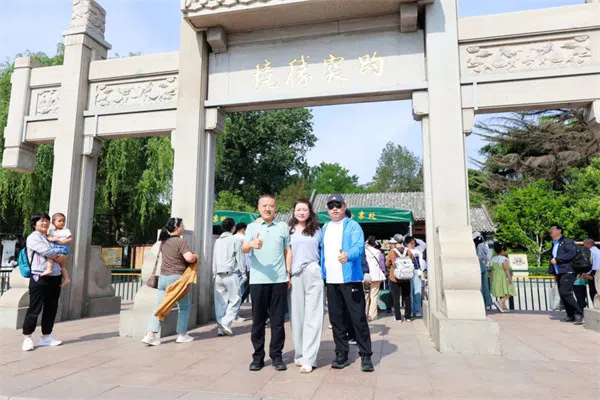
On May 22, the “Zongheng Sihai” expansion team of Cheung Kong Graduate School of Business arrived in Jinan, Shandong. Over the next three days, everyone will jointly tour the land of Qilu with its profound cultural heritage and appreciate the cultural Shandong of “one mountain, one river, one sage.”

People from various places and industries gathered at Zhongru Kexinda Construction Group to conduct in-depth discussions on how enterprises should break through in the current market environment. The chairman of Zhongru Kexinda Construction Group proposed to “view the Earth from the Moon,” raise one’s perspective to an international and global level, and at the same time make corporate culture the internal driving force of enterprise development.
Cheung Kong Graduate School of Business not only cultivates people’s global vision and ability to integrate global resources, humanistic care and social responsibility, and innovative spirit; the CKGSB Alumni Association also provides entrepreneurs and enterprise managers with a bridge for communication and a bond for mutual help and support.
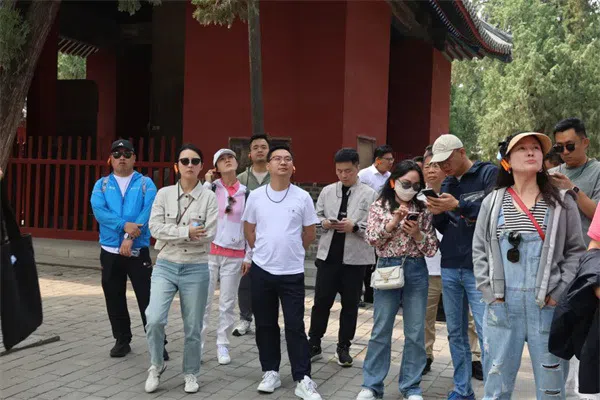
In the first half of the year, the third session of the 14th National People’s Congress concluded successfully, national policies gradually became clearer, and the current social situation and industry trends are unprecedented, containing both opportunities and hidden crises. In 2023, Zhongru Kexinda Construction Group proposed for the first time the building of a “hundred-billion-level community, trillion-level alliance.” The community is a creation under crisis; the impact of emerging industries on traditional industries is unprecedented, and in the face of the current situation, going it alone will ultimately lead to demise. Building the community is imperative. Only by unswervingly building the community and making enterprise development closely tied to individual destiny can everyone unite with all their strength and move forward hand in hand.
The first stop of the erudite study tour is “Qufu,” an ancient city located in southwestern Shandong that carries profound cultural symbols of Chinese civilization. Confucius, the founding ancestor of Confucianism and the supreme sage and teacher, was born, taught, and spent his final years here. With the bearing of being ordinary yet sage, he integrated worldly life with spiritual transcendence, making Qufu an “earthly sacred realm.”
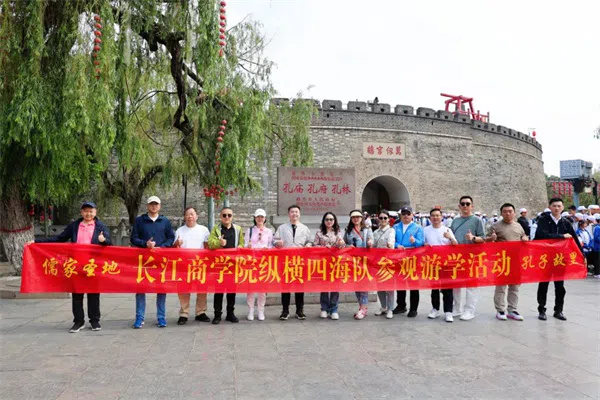
The Three Confucian Sites: the Temple of Confucius, the Mansion of Confucius, and the Cemetery of Confucius are wonders in the history of human civilization. The Temple of Confucius began as three rooms and, after more than 2,000 years of expansion, evolved into a magnificent temple complex with 466 buildings. The Mansion of Confucius, as the residence of the “Yansheng Duke,” consists of 463 rooms in a nine-courtyard complex and is known as “the finest family under heaven.” The Cemetery of Confucius, covering more than 3,000 mu, uses the layout of “carrying the son and embracing the grandson” to melt filial piety ethics into national memory.
Since its emergence, Confucianism has deeply influenced the course of Chinese civilization and even world history. Zhongru Kexinda Construction Group has always taken Confucianism as the group’s guiding ideology, adopted “education as the foundation, letting leaders make leaders” as its corporate values, and integrated Confucian culture into daily life and work. It is necessary both to uphold the spiritual height of “looking up to the high mountain” and to complete the practical transformation of “unity of knowledge and action.”
The exploration of Qufu is a dialogue spanning a thousand years. This city is not a storage device of history but a generator of history. From the obscure words on ancient bamboo slips to detailed interpretations in cloud databases, AI figures’ vivid performances make stories from a thousand years ago come alive before our eyes.
The ultimate statement in The Analects, “Set your heart on the Way, base yourself on virtue, rely on benevolence, and wander in the arts,” fuses the pursuit of knowledge and the perfection of personality into a unified process. In today’s rapidly developing era, utilitarianism fills every stage of life. Confucius’s warning that “the gentleman is not a vessel” is like a morning bell and evening drum, warning that true erudition should not become a stepping stone for chasing fame and fortune, but should become the North Star illuminating the human spiritual world.
The progress of the current era and the development of technology are unprecedented. When using AI to run the semantic analysis program of The Analects, Confucius’s saying, “Scholars of ancient times studied for themselves; scholars of today study for others,” keeps flashing in every corner. This thought from a thousand years ago is still continuously influencing cultural progress.
Earnest practice: “Study it extensively, inquire into it accurately, think over it carefully, sift it clearly, and practice it earnestly.” Learn in order to apply; unite knowing with doing.
The second stop of the study tour is at the summit of Mount Tai, the paramount of the Five Great Mountains. From the Wordless Stele erected by Qin Shi Huang to the Five-Pine Tree planted by Emperor Wu of Han, from the Tang Xuanzong cliff inscription “Inscription of Mount Tai” to the Qianlong imperial brush words “Indeed like Us,” this 7.5-kilometer imperial climbing route is truly a time tunnel for decoding the genes of Chinese civilization. Mount Tai has never been a silent giant rock, but a living epic that records civilization through geological growth rings.
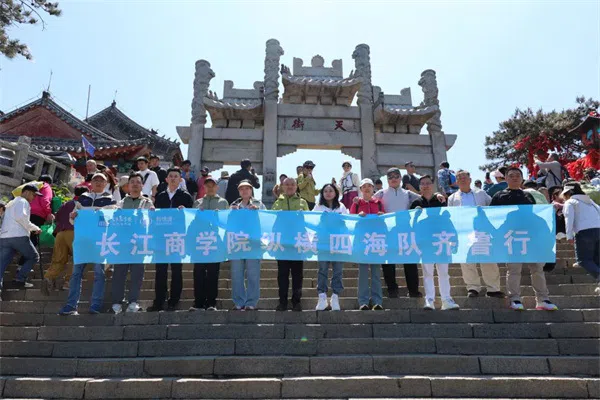
From the First Heaven Gate to the Jade Emperor Peak, there are more than 6,000 steps; every stone of Mount Tai is engraved with a code of time. The 1,600 steps of the Eighteen Bends have on average each borne 300 million footfalls, and the sunken step surfaces tell the story of history. This is vivid material evidence of “earnest practice”: perseverance is not shown off in grand narratives, but lies in the power precipitated through billions of repetitions that changes material form.
Ascending the Jade Emperor Peak, one experiences Confucius’s realization from two thousand years ago that “climbing Mount Tai makes the world seem small”; seeing it in person also gives rise to new understanding. “Earnest practice” lies not only in the conquest of the moment of reaching the summit, but even more on the descent, in blending the soul of the mountain into one’s spiritual bones and blood, and carving unwavering conviction deep into the heart.
Bronze locks chime in the wind; those metal plates engraved with wishes are forging countless people’s hopes into part of the mountain itself. Looking back at the outline of Mount Tai when leaving, it offers no answers, yet teaches how to coexist with questions. When the city neon pours back into view, the Mount Tai dust clinging to the hem of one’s clothes looks like a painting under the streetlights—a plain amulet bestowed by the mountains, reminding one that at some moment, one touched the outline of eternity.
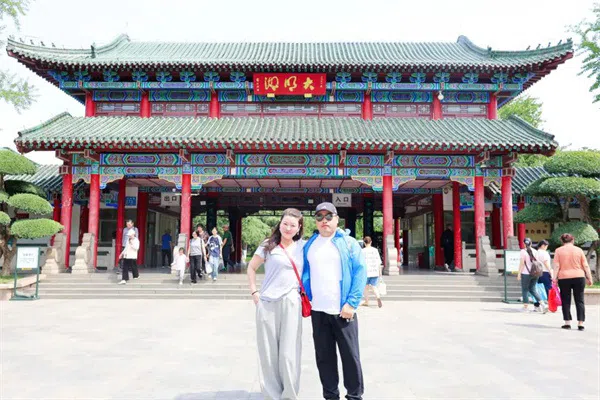
The highest good is like water: water benefits all things and does not contend.
This study tour will conclude in Jinan. The City of Springs, Jinan, has springs unrivaled under heaven: Jinan has 72 famous springs, more than a hundred large and small spring pools, and over a thousand spring mouths. Among them, “Baotu Spring” is known as “the finest spring under heaven.” Three columns of water leap out from between the bluestones, flowing unceasingly for a thousand years, interpreting tireless vitality.
In the limestone strata of the Mount Tai range south of Jinan, rainwater is filtered and permeated layer by layer, forming a vast underground river system beneath the ground. When this groundwater meets the impermeable granite layer to the north, tremendous water pressure forces the flow to burst out from fissures in the strata, creating the world-rare artesian spectacle at Baotu Spring.
Li Daoyuan of the Northern Wei described it in the Commentary on the Water Classic as “the spring source surges upward, the water gushes like a wheel,” and Zhao Mengfu of the Yuan dynasty, with the line “a white jade pot gushes forth from level ground,” fixed this wonder in the scroll of history.
Passing through the couplet “lotuses on four sides, willows on three,” Daming Lake spreads out its clear 46-hectare surface as a Jiangnan of the North. This lake, whose water is completely renewed by spring water every ten days, hides the natural code of “no snakes to be seen, no frogs to be heard”—low water temperature and waterbird ecology suppress the breeding of frogs and snakes, yet give rise to the ecological wonder of “not rising in constant rain, not drying in long drought.”
From the “Luo River” recorded in the oracle bone inscriptions of the Shang Dynasty, to the spring data dancing on digital screens; from the lotus ponds once rippled by Emperor Qianlong’s imperial boat, to the dazzling sea of lights viewed from drones, the springs of Jinan have always flowed through reconstruction and inheritance.
A handful of clear spring water lets you touch not only the memory of underground rock layers, but also the code by which a city turns nature’s gift into civilizational resilience. Whenever the spring wind blows, a harmony spanning a thousand years resounds, playing an eternal movement jointly composed by the earth and human culture.
Zhongru Kexinda Construction Group is located in Jinan, Shandong Province. It takes Confucianism as its guiding ideology, adheres to putting education first, and encourages employees to keep learning, keep improving, and keep transforming themselves. At the same time, it must remain true to its original aspiration, keep its mission firmly in mind, assume social responsibilities, fulfill social obligations, and practice social commitment, contributing its strength to the realization of the great Chinese Dream.
Learning has no end, and truth is infinite, yet every step forward brings its own joy. Broad learning warns us not to settle in one corner but to understand the affairs of the world. Knowledge lies in ancient books and also in brand-new technology; in whatever way, new knowledge can be learned. Looking down at flowers and trees, learn their non-contention; looking straight at flowing water, learn its formlessness; looking up at the horizon, learn its boundlessness. The natural laws governing the development of all things in the world inherently contain endless philosophy and also reveal future possibilities.
Only through earnest practice can one go far. Turn what is in the heart into the road beneath the feet, keep watch over the original aspiration of the soul, bow the head and cultivate deeply in the recurring ordinary days, carve eternal growth rings into the time of the mind, and let every tiny footprint become a step toward distant places. It has no sharp edges, yet flows with the power to pierce through time; it has no fixed form, yet in change reflects the truth of nature. The goodness of water lies first in its softness, in staying low, in non-contention, in constant change and constant constancy: meeting cold it becomes ice yet remains clear; receiving heat it turns to vapor and falls as rain on the plains. Through millions of changes, it still keeps its original aspiration.
The highest good has never been an unreachable moral benchmark; it is more like a way of living close to the essence of life: listen to the inner voice amid the clamor, embrace a broader world with an attitude of non-contention, and let those distant stars become guiding lights on the road ahead.