


Recently, regarding whether the conversion of existing mortgage pricing benchmarks to the Loan Prime Rate (LPR) starting March 1 will continue, a central bank official stated that after careful research, the decision has been made not to change the plan and to proceed as scheduled.
This means that the “mortgage benchmark switch” determined at the end of last year will proceed as planned, officially taking effect in March, and the major real estate market shift of 2020 has finally arrived. So, what exactly does the mortgage rate benchmark switch mean? How much impact will it have?
1: What is the mortgage benchmark switch?
The mortgage benchmark switch is undoubtedly one of the major changes in the real estate market in 2020. The so-called mortgage benchmark switch refers to converting all existing mortgages to the “LPR model.” In the future, all mortgages will use the LPR rate as the reference benchmark. Whether mortgage rates rise or fall, increase or decrease, will depend on the LPR rate.
To explain, in the past, when we bought homes, the policy rate served as the benchmark, which was set by the state and typically adjusted only once every few years. The current policy benchmark loan rate is 4.9%, and it has remained unchanged since 2015. However, in recent years, not only have domestic and international economies undergone dramatic changes, but the real estate market is no longer what it used to be. The policy benchmark rate, unchanged for five years, clearly cannot adapt to the evolving situation. Hence, the LPR rate emerged. This rate is based on comprehensive quotes from multiple commercial banks, representing the market rate, and is released by the central bank on the 20th of each month, constantly changing.
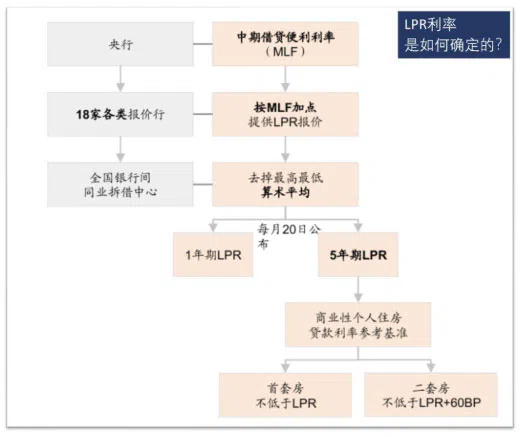
The LPR rate is divided into a 1-year LPR rate and a 5-year LPR rate. The former mainly targets real economy enterprises, while the latter is oriented toward real estate. This approach not only brings interest rates closer to the real market but also makes targeted regulation of the real economy and the real estate market possible.
2: Is everyone required to convert?
Is everyone required to undergo LPR conversion? Yes, regardless of whether the mortgage is new or old, even those signed ten years ago, all must undergo LPR conversion. This policy is mandatory, with no room for choice. The exception is if a mortgage is due to mature within one year, in which case conversion no longer matters. LPR conversion will begin on March 1 and is expected to be completed by the end of August. Once the detailed rules are released, major commercial banks will handle the process, which can be done offline or online.
3: How to convert?
For new homebuyers and existing homebuyers, what is the difference in the LPR model?
For homebuyers after March 2020, the mortgage rate = 5-year LPR rate + local basis points.
Among these, the 5-year LPR rate is released by the central bank on the 20th of each month and adjusted monthly, with the latest value taking effect, while the basis point addition is determined locally.
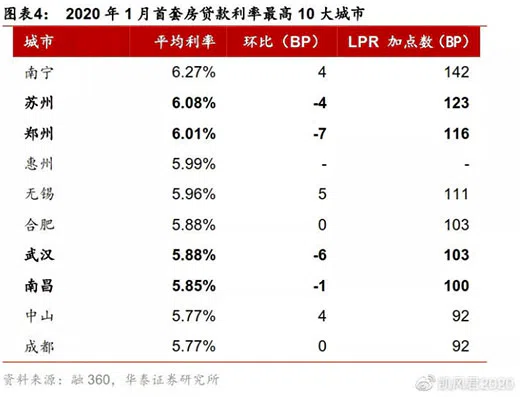
For example, in February 2020, the new 5-year LPR rate was 4.75%. Suzhou's first-home mortgage added 123 basis points (one basis point equals 0.01%), so the current mortgage rate equals 5.98% (4.75% + 1.23%). Similarly, Beijing's first-home mortgage only adds 50 basis points, so Beijing's first-home mortgage rate equals 5.25% (4.75% + 0.5%). For old borrowers with existing mortgages from before 2019, starting in March, all must convert to the LPR model and determine the basis point addition.
Once the basis point addition is determined, it remains unchanged throughout the entire 20- or 30-year repayment period.
Fourth: How are basis points determined?
It is clear that basis points are the key of keys. We have already learned that for new homebuyers, the basis points are determined by each locality. Basis points are similar to the previous markup ratios of 20% or 30%. Of course, just like markup ratios, depending on the stage of property market regulation and the city, the basis point addition varies greatly—some cities add 50 basis points for first homes, while others add 100 basis points. For old borrowers, the basis point addition is determined using the “back-calculation method,” where the basis point value is the difference between the original contract rate and the 5-year LPR for December 2019 (which was 4.8% that month), adjusted once a year.
Simply put, basis points = current actual mortgage rate − 4.8%. To give a simple example, if the 2018 contract mortgage rate was 5.39%, after the anchor switch, the basis point addition = 5.39% − 4.8% = 59 basis points. Note that once the basis points are determined, they accompany the entire repayment period.
Fifth: Do mortgage discounts still exist?
Discounts still exist because basis points can be negative. As is well known, before 2017, especially in 2014 and 2015, commercial loan rates in many cities started at a 20% discount, and mortgage rates at that time were far below the 4.9% benchmark rate.
Again, take a simple example: if someone bought a home in 2015 with a 15% discount on the mortgage, the actual rate was 4.165%. So after the mortgage rate conversion, what does the new mortgage look like? Basis points = actual mortgage rate (4.165%) − 5-year LPR for December 2019 (4.8%) = −0.635% (−63.5 basis points). Yes, you read that correctly: after the mortgage anchor switch, the new mortgage rate = new 5-year LPR rate − 63.5 basis points, and the discount still exists. Similarly, if the 5-year LPR rate drops to 4.7% in 2021, then the actual mortgage rate for that year can be adjusted to 4.065% (4.7% − 63.5 basis points), and the borrower benefits from this discount throughout the entire repayment period.
Six: Should you choose a fixed interest rate or one that changes annually?
This time, the mortgage interest rate anchor switch gives everyone a chance to change their mortgage. The central bank offers two options: first, choosing a fixed interest rate, which will remain unchanged throughout the entire 20- or 30-year mortgage cycle. If the actual interest rate before 2019 was 5.39%, choosing a fixed rate means it will stay at 5.39% for the next 20 years. Second, a floating rate that changes once a year. The mortgage rate can be adjusted annually; if the new LPR rate drops that year, the mortgage rate will drop accordingly. There is only one chance. So, should you choose a fixed rate or a floating rate that changes annually? The answer is clear: choose the floating rate that changes annually. The advantage of a fixed rate is that if interest rates rise in the future, your rate will not follow the increase. The advantage of a floating rate is that if interest rates fall in the future, the mortgage rate can be adjusted continuously. It is not hard to see that the key issue is whether the future will be a major rate-hiking cycle or a major rate-cutting cycle. It should be noted that declining interest rates are the general trend. Currently, the global economy has entered an era of broad easing, with lower interest rates being the general trend. Many European and American countries have already entered negative interest rate territory, and our country's interest rates have fallen significantly compared to a few years ago.
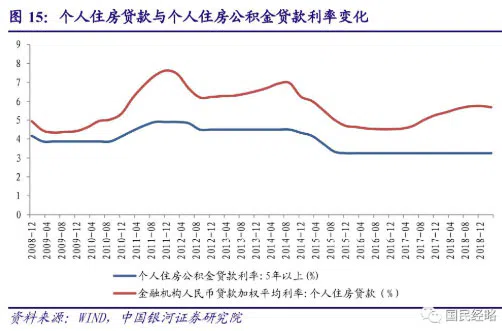
In China, the benchmark mortgage rate around 2010 was close to 7%, but now it is below 5%. The continued decline in interest rates may be the general trend for the next 5 to 10 years. Against this backdrop, a fixed rate clearly runs counter to the trend of the times.
Seven: Will mortgage rates rise or fall?
At least in 2020, mortgage rates will remain unchanged. In other words, whatever your actual mortgage rate was in 2019, it will remain the same after the anchor switch, which is why the central bank has repeatedly emphasized that mortgage rates will not change. For example, if the actual mortgage rate in 2019 was 5.39%, then the actual mortgage rate in 2020 will still be 5.39%. The difference is that the 5.39% in 2019 was due to a 10% increase over the policy rate (4.9%*1.1), while the current 5.39% is due to a markup over the 5-year LPR (4.8% + 59 basis points). What about 2021? Note that the mortgage rate can be adjusted once a year, and the specific month of adjustment depends on the contract. For example, if the adjustment is made in May 2021, then the mortgage rate for 2021 = the new 5-year LPR rate in April 2021 + 0.59%. If the 5-year LPR rate drops to 4.6% at that time, the mortgage rate for 2021 will drop to 5.19% accordingly.
Eight: What impact will this have on provident fund loans?
This mortgage rate anchor switch mainly applies to commercial loans and does not affect provident fund loans for now. As is well known, provident fund loans are policy loans, with rates far lower than commercial loans. Since 2015, commercial loan rates have climbed from 4.9% to around 6%, while provident fund loan rates have remained at 3.5%. Therefore, precisely because provident funds offer policy benefits, along with factors such as reasonable tax avoidance and effects on actual income, Huang Qifan's recent suggestion to “abolish the housing provident fund” stirred up a huge wave of controversy.
Nine: What is the power of the mortgage anchor switch?
Why did the central bank carry out the LPR model reform? Two reasons: first, to advance interest rate marketization reform, as the monthly updated LPR rate is clearly better able to adapt to rapidly changing market conditions. Second, to separate the interest rates of the real estate market from those of the real economy, making targeted regulation of the property market possible. This time, the central bank created the “1-year LPR rate” and the “5-year LPR rate,” with the former targeting the real economy and the latter targeting real estate, and these two rates do not move in sync. It should be noted that in the latest rate announcement, the 1-year LPR was cut by 10 basis points, while the 5-year LPR was cut by only 5 basis points. Over the past year, the 1-year LPR has been adjusted four times, with a cumulative cut of 26 basis points, while the 5-year LPR has been adjusted only twice, with a cumulative cut of 10 basis points. This is the power of targeted regulation and asymmetric rate cuts.
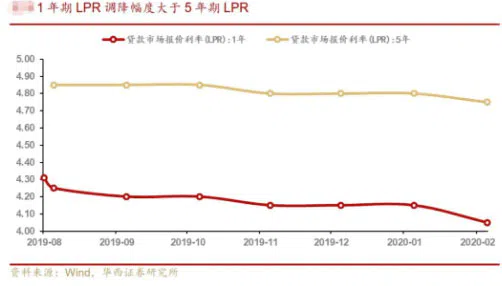
To cope with the impact of the epidemic, the real economy can see significant rate cuts, but to prevent a flood of liquidity from pouring into the property market, real estate can only see small rate cuts or none at all. In the future, a scenario is likely to emerge: real economy rates continue to decline, while real estate rates not only fail to follow the decline but remain unchanged or even keep rising. Targeted rate cuts for the real economy plus “targeted rate hikes” for the property market are not impossible. This is the regulatory landscape we must face anew in 2020. In the future, the tools for regulating China's property market will only increase, restrictions on the property market will only tighten, and the era of unregulated policy has long since passed.